Passing an Evaluation and Qualifying for a Payout Are Different
Map stage-specific rules, equity boundaries, prohibited conduct and payout conditions before treating a target as the complete prop-firm task.
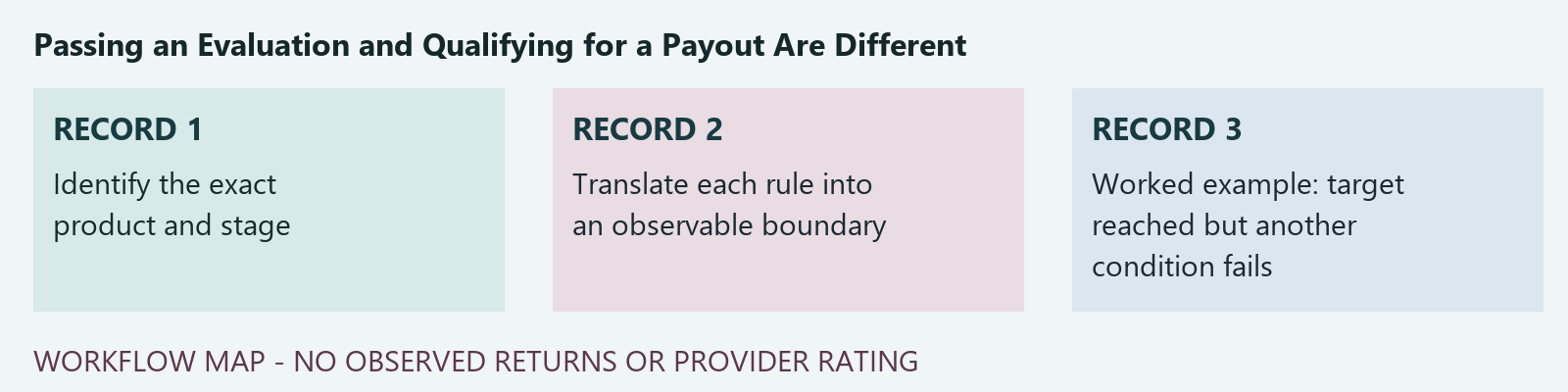
Identify the exact product and stage
Record firm, legal offer, account class, evaluation version and current stage. Similar product names can hide different objectives, loss rules and account conditions. Save the actual terms rather than an affiliate summary. A simulated evaluation, later funded arrangement and payout request are separate states. Do not infer account ownership, broker execution or a guaranteed commercial relationship from the word funded. This guide explains a rule-reading process, not a recommendation, purchase or assurance that a particular firm is suitable.
Translate each rule into an observable boundary
Identify which balance or equity quantity is measured, the observation frequency, fees included, reset time and whether the boundary is static or trailing. The official FTMO Academy lesson illustrates one product-specific daily-loss mechanism; it must not be copied as the rule for every firm or tier. Record current source text and unanswered interpretations for the exact offer. A remembered percentage is not enough to reconstruct whether a position complies during the session or after a reset.
Worked example: target reached but another condition fails
Invent an evaluation with a profit objective of 500 units and a minimum of four qualifying days. A fictional account earns 520 in two days. It satisfies the invented profit amount but not the invented day requirement. Another offer might have no such rule; do not transfer the example to a real firm. This illustrates a conjunction of conditions rather than a pass probability. The correct worksheet records each requirement independently, including whether the firm confirms the interpretation, instead of giving one overall pass label from profit alone.
Keep behaviour restrictions separate from performance
Inspect rules on news, overnight exposure, instruments, copying, automation and account access if present in the actual contract. A strategy can have an attractive research result while violating the purchased offer's permitted behaviour. Do not infer permission from a signal provider saying its calls work with prop accounts. A conviction grade is not an account compliance certificate. Save requests and written answers for ambiguous cases; an unsupported interpretation should remain unresolved rather than becoming trading advice.
Read the transition and payout requirements
After an evaluation objective, identify what review, identity checks, agreement, trading period and payout conditions are required by the actual arrangement. Preserve any stage change in the rule version. A headline split cannot establish net payout after all relevant conditions, charges and eligibility questions. Do not enter new paid stages merely to verify a speculative claim. The comparison can be valuable by exposing the contract questions while leaving current commercial eligibility and legal interpretation to the actual terms and qualified advisers.
Use a requirement register, not a shortcut
Maintain one row per rule with source, clock, quantity, observed state and unanswered issue. Keep account evidence distinct from hypothetical challenge planning or a provider's reported model results. No pass rate, payout probability or independent firm certification is supplied by this protocol. A useful decision may be declining an offer whose constraints do not match your available time or understood strategy. The blank register makes the task legible without pretending that reaching a target guarantees completion, account access or a later payment.
Decision record
| Question | Record to retain | Decision boundary |
|---|---|---|
| Stage | Offer version and account class | Evaluation and payout are different states |
| Boundary | Measured quantity, reset clock and source rule | A percentage alone cannot describe compliance |
| Conduct | Actual restrictions and written interpretation | Research performance does not imply permitted use |
| Payout | Stage-specific agreement and eligibility conditions | Target achievement is not a payment guarantee |
Blank working record
The worksheet contains column headings only. Enter your own dated observations, keep absent evidence marked unknown, and do not treat the file as certification.
 Download worksheet (CSV)
Primary references
- FTMO Academy: one product-specific daily-loss rule
- SEC: order types and execution limitations
- FTC: endorsements and reviews
These documents support mechanisms and source definitions, not a tested trading result or a recommendation. Accessed 9 October 2026. The decision workflow and invented examples above are editorial exercises.
Keep reading
Publication methodology | Working glossary | Source and correction policy
Keep the interpretation contract with the calculation
The new forms require explicit operators, net cost convention, day basis and session grammar. A valid input combination implements that declared exercise only. It does not authenticate a rule source, fill missing coverage or verify which contract governs an account. Preserve source and observation identity beside the export rather than treating a working calculator as programme approval.
Inspect the complete teaching population
The packet has seven invented account observations, six explicit policy cases and five base closed daily rows. It also retains missing-equity, unmodelled-flow, changing-best-day and undefined-denominator variants. Keep the active reference, monitored measure, operator and observation scope with each comparison. A true arithmetic condition is not a programme pass, and a later recovery does not erase an earlier supplied exception. No row is a participant outcome, broker event or payout record. Genuine account decisions require their own applicable documents and authoritative state.